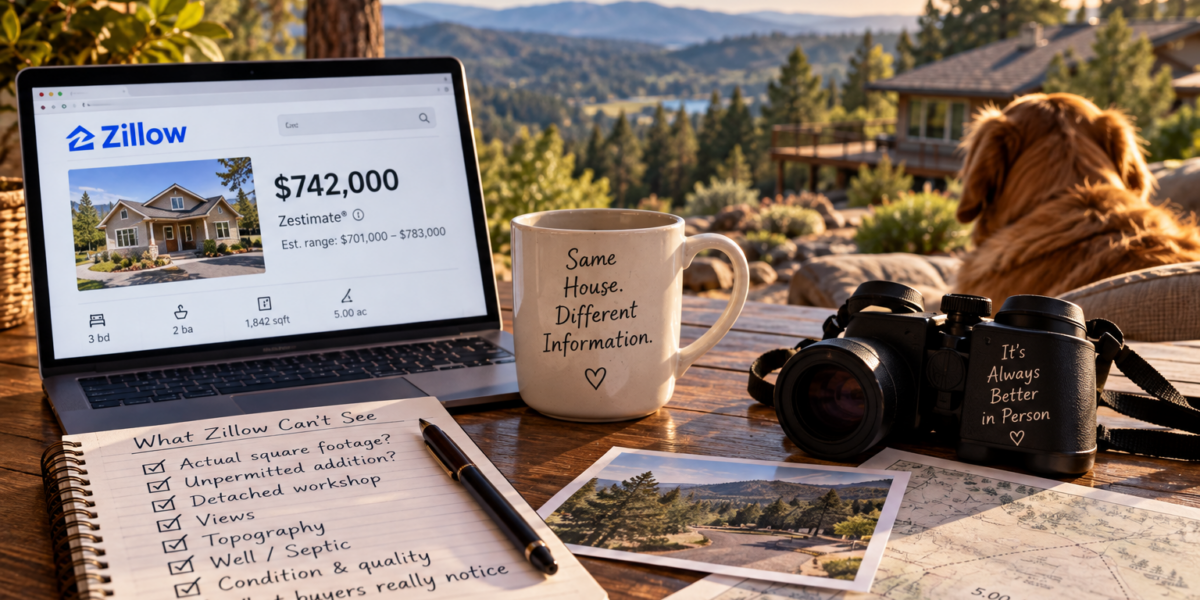
A homeowner once walked me through a house while explaining, room by room, why the number on Zillow couldn’t possibly be right.
The kitchen had been remodeled. The primary bathroom was newer. There was a workshop out back, a view from the rear deck and an addition that didn’t appear to be reflected correctly in the county records. By the time we reached the living room, I had been given a fairly compelling argument that the computer didn’t know the house very well.
Then I started looking at the market.
The uncomfortable part was that Zillow’s number wasn’t crazy.
That’s worth admitting.
Automated valuation models can be remarkably good at what they do. Give a computer reliable information about a relatively typical house in a neighborhood filled with similar houses and plenty of recent sales, and it can process an enormous amount of data very quickly.
Sometimes the result will land surprisingly close to where an appraiser eventually lands.
Sometimes it won’t.
The interesting question isn’t whether the computer or the appraiser is smarter.
It’s what does each one actually know about the house?
Zillow Has Seen a Lot More Houses Than I Have
There is no point pretending humans can compete with computers at processing enormous amounts of data.
We can’t.
Automated valuation models, or AVMs, can draw from property records, sales information, tax data and other available sources, then use statistical models to estimate a property’s value. Zillow calls its estimate a Zestimate, but Zillow isn’t alone. Similar technology appears throughout real estate, mortgage lending and property-data systems.
For the right property, that’s powerful.
Imagine a subdivision built twenty years ago with four basic floor plans. Your house is one of 300 relatively similar homes, the public record accurately describes it, and twelve reasonably comparable properties have sold recently.
The computer has plenty to work with.
It doesn’t need to walk through all 300 houses to recognize relationships in the data.
But now leave the subdivision and drive into the foothills.
Things can get weird pretty quickly.
The County Says 1,842 Square Feet. The Owner Says 2,400.
Now we’re standing in front of a house on five acres.
The county record says 1,842 square feet.
The owner says it’s closer to 2,400.
An old MLS listing says 2,116.
There’s clearly a room behind the garage that wasn’t part of the original house. The owner calls it a bedroom. Someone else might call it an office. Whether it was permitted may require another conversation entirely.
Out back there’s a detached building. Is it a garage? A workshop? An accessory dwelling unit? A very ambitious shed?
There is also a well, a septic system, a seasonal creek, a steep portion of the acreage and a view that becomes much more impressive once you walk around the side of the house.
The computer hasn’t become stupid.
Its problem has become harder.
Before any model can estimate the value of that property, it has to know what property it’s estimating.
And sometimes the information available to the model doesn’t describe what is actually sitting on the ground very well.
A Database Contains a Version of Your House
This is one of the stranger things you discover after enough years of appraisal work.
A house can have several identities at once.
The assessor may describe one version. The building department may have another. An old MLS listing may describe something slightly different, and the homeowner may have an entirely different understanding of the property.
Most of the time those differences are relatively minor.
Sometimes they aren’t.
A garage was converted years ago. An addition was built. A wall came down. A second living area appeared. A manufactured home was added to the land. The kitchen was completely remodeled, while the public record quite reasonably continued reporting the same bedroom count, bathroom count and square footage it had before.
Data systems are extraordinarily useful. We use them every day.
But a database contains a representation of the property. The property itself gets the final word.
That’s one thing physically seeing a house can change.
The Computer Can’t Stand in the Backyard
Suppose two houses really are nearly identical.
Same subdivision. Same model. Same square footage. Same age.
One backs to open space.
The other backs to a road carrying thousands of cars every day.
A sufficiently sophisticated model may have information that helps it recognize that difference. Location data are increasingly detailed, and it would be foolish to assume modern AVMs are simply comparing bedroom counts and square footage.
But there is still a difference between locating a property on a map and standing in its backyard at five o’clock in the afternoon.
The same is true of views, privacy, topography, awkward additions, deferred maintenance, remodeling quality and dozens of other characteristics that can affect buyer reaction.
A photograph can show me a kitchen was remodeled.
Walking through it may tell me the cabinets are peeling, one drawer doesn’t close and the refrigerator door hits the island.
A record may tell me the property has ten acres.
Walking the land may reveal that much of it is steep enough that the most useful part of the property is concentrated around the house.
Neither fact automatically tells me how much buyers will pay for the difference.
But first, somebody has to notice the difference exists.
Humans Have Bad Data Too
Before this starts sounding like an argument for the superiority of appraisers, we should probably admit something else.
We get things wrong.
Appraisers work with many of the same imperfect records everyone else uses. We can measure incorrectly. We can miss a feature. We can select a sale that deserves less weight than we gave it. We can interpret market evidence differently from another competent appraiser.
Being human doesn’t make someone right.
And being a computer doesn’t make something wrong.
The advantage of an appraisal isn’t that a person possesses some magical ability to look at a house and know its value. The advantage is that the appraiser can investigate the specific property, question conflicting information, select relevant market evidence and explain how the analysis led to the conclusion.
If the county says 1,842 square feet and I measure something substantially different, I don’t have to pick whichever number I like better.
I have a problem to solve.
That’s the work.
Sometimes Zillow Is Right
I think homeowners occasionally expect appraisers to enjoy proving Zillow wrong.
I don’t.
If the Zestimate says $800,000 and my analysis indicates $805,000, that’s not disappointing. It means two different valuation processes looked at the available evidence and ended up in roughly the same neighborhood.
There are places where I’d expect that to happen fairly often.
A subdivision with highly similar housing, good public data and frequent sales is exactly the kind of environment where automated models have an advantage. There is a lot of information and relatively little mystery.
Now give the model a hundred-year-old foothill house on acreage with several outbuildings, an uncertain addition, a private well, unusual topography and three comparable sales scattered across fifteen miles.
That’s a different problem.
Not necessarily impossible.
Just harder.
And frankly, it’s harder for the appraiser too.
The Number Isn’t Really the Most Interesting Difference
When people compare an appraisal with an online estimate, the conversation almost always becomes:
Which number is right?
That’s understandable. The number is what everyone came for.
But there is another difference that may matter more.
Can you see how the number was developed?
If an appraisal says $825,000, there should be an analysis behind it. You can look at the comparable sales. You can see how the appraiser described the property. You can ask why one sale was considered more relevant than another. You can point out something that appears to have been missed.
An automated estimate is doing its own analysis, often using methods far more mathematically sophisticated than anything visible to the homeowner. But the homeowner generally isn’t sitting beside the model while it works through the property saying, “Hold on, that square footage is wrong,” or “You know the house across the street doesn’t have the same view, right?”
That’s a meaningful difference when the property itself is complicated or when the answer matters enough that somebody may eventually need to defend it.
So Should I Ignore Zillow?
No.
Look at it.
Look at other online estimates too. Look at the houses selling around you. Pay attention to what your neighbors list for and what they actually sell for.
Information is useful.
If Zillow says $850,000 and every house you can find seems to be selling around $650,000, that’s interesting.
If Zillow says $650,000 and the three closest model matches just sold between $825,000 and $875,000, that’s interesting too.
An online estimate can be a very good reason to start asking questions.
It just shouldn’t automatically end them.
Because somewhere behind every estimate is a collection of information describing your property, and sometimes that description is excellent.
Sometimes it’s incomplete.
Sometimes it’s wrong.
And sometimes the number is remarkably good anyway.
That’s why the most useful question may not be, “Does Zillow know what my house is worth?”
It may be:
“How well does Zillow know my house?”
Christopher Pyle has more than 20 years of real estate appraisal experience in Northern California. He works alongside his mother, longtime appraiser Christine Pyle Banks, at AppraiserChris.com, their family appraisal practice serving the Sacramento region and Sierra Nevada foothills. His work focuses on helping homeowners, families and professionals better understand property value and the decisions that surround it.