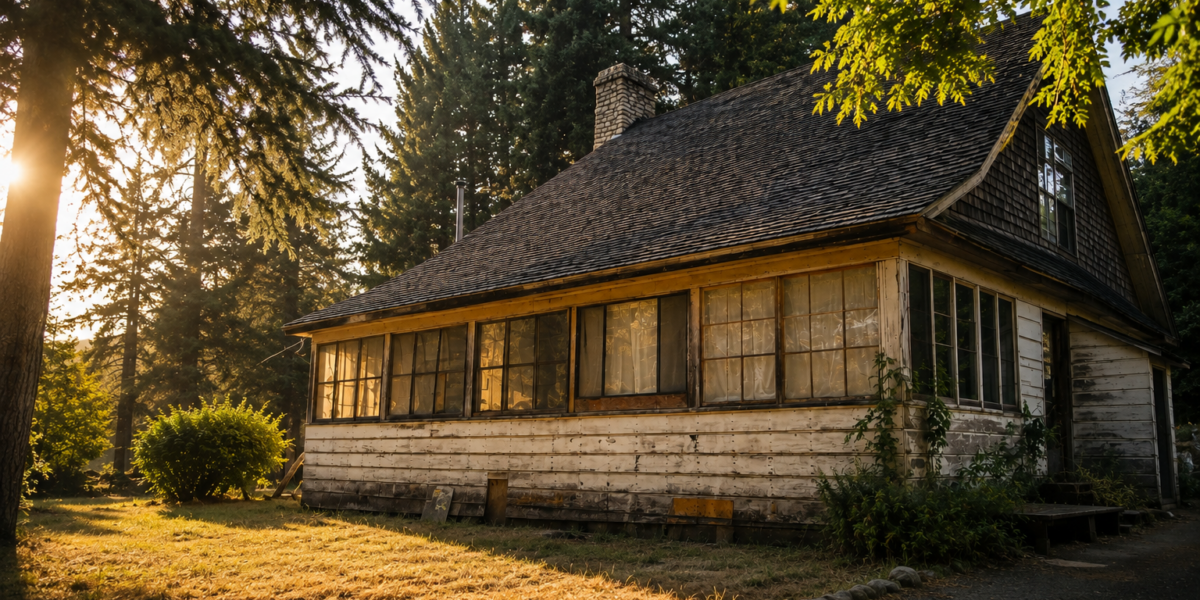
There is a strange thing that happens to a house when someone dies.
For forty years, it may have simply been home: Mom’s, Dad’s, Grandma’s or Grandpa’s.
It was where the family gathered, where birthdays and holidays happened. Where the family’s history was stored, where generational Christmas decorations, photo albums, and stories lived. Where the good towels remained on display and were never used. Where grandchildren stole Grandpa’s snacks from his secret drawer and everybody knew how to open the back door that stuck when it rained.
Nobody thought much about it as a building, about its worth. It was simply home.
Then Mom passes away, and suddenly everyone sees home as a thing, a building that needs a number.
The attorney needs one. The accountant may need one. It can feel cold, transactional, as if the heart is gone. The trust or estate has decisions to make. There may be tax considerations. One child may want to keep the house while another would rather sell it. Someone has looked online and found an estimate. A real estate agent may have offered an opinion. And almost overnight, the place where a family’s life happened has also become an asset that needs to be valued.
Those two realities can be surprisingly difficult to hold at the same time.
I see this fairly often in appraisal work. I walk into a home to answer what sounds like a straightforward question about value, but I’m also walking into somebody’s history.
Sometimes the house looks almost exactly as it did twenty or thirty years ago. Family photographs line the hallway. There are handwritten measurements of children and grandchildren inside a door frame. Dad’s tools are still organized in the garage according to a system nobody else quite understands. The furniture may have been in the same place for decades.
To an appraiser, those things generally aren’t part of the property’s market value. To the family, they may be the most valuable things in the house. Both can be true.
This dichotomy of emotions, family, heart and home versus size, condition and location can make the technical aspects that follow a death difficult. Emotions span the spectrum, and yet a technical, procedural process still needs to happen.
The Date Matters
One of the first surprises for many families is that the question isn’t always, “What is the house worth?” Rather, “What was the house worth on the date Mom died?”
That’s an important distinction.
This is commonly called a retrospective appraisal or date-of-death appraisal. For estate administration and tax purposes, what is often needed is the property’s value as of the date of death, rather than its value months or even years later when the appraisal is ordered. Instead of developing an opinion of value as of today, the appraiser goes back to that specific date and analyzes the market as it existed then.
Sometimes that date was recent. Sometimes considerable time has passed.
Either way, we can’t use today’s market and simply work backward from it. The assignment requires us to look at what buyers and sellers actually knew and were doing around the effective date of the appraisal.
Appraiser considerations may include: What homes were competing with this one? What had recently sold? How long were properties taking to sell? Were buyers paying above asking price, negotiating discounts, or walking away? What was happening with interest rates and inventory? And perhaps most importantly, what would buyers at that time have considered reasonable alternatives to this particular property?
The appraiser is, in a sense, reconstructing a market that has already passed. That can matter for estate administration and tax purposes, but it can also matter for something much more personal: giving everyone involved a common point of reference.
Because Everyone Already Has a Number
This is another very human part of the process.
Long before an appraiser arrives, people usually have opinions. Someone has checked an online valuation. Someone remembers what the neighbor’s house sold for. Someone knows how much Mom spent remodeling the kitchen. Someone else thinks the property is worth considerably more because “you just can’t find houses like this anymore.”
There are a lot of unknowns around these processes. For most of us, this is a first experience, and it’s overwhelming. The ideas and thoughts above aren’t wrong; they’re just not addressing the appraisal question.
An automated valuation, like Zillow, may be interpreting public records and nearby sales. A real estate professional may be considering a likely listing strategy. A family member may understandably be thinking about everything that has been invested in the property over the years.
An appraisal asks a different question.
What does the evidence indicate about how the market would have viewed this particular property as of a particular date? That requires more than finding a few nearby sales and averaging their prices.
Two houses on the same street can appeal very differently to buyers. Acreage, condition, quality, remodeling, views, outbuildings, location influences, floor plan, permitted and unpermitted improvements, deferred maintenance and dozens of other characteristics can affect how buyers respond to a property.
Sometimes the best comparable sale isn’t the house three doors down. Sometimes it’s several miles away. The job is to understand which properties buyers would actually have considered alternatives and what those transactions tell us about the subject property.
A Neutral Number Can’t Solve Everything
Property decisions after a death often aren’t purely financial. People are grieving. One person may be ready to move forward while another isn’t. One sibling may see an aging house requiring substantial work. Another still sees the home where everyone gathered every Christmas morning. Neither perspective is necessarily unreasonable.
An appraisal isn’t going to resolve all of that, nor should anyone pretend it can. What it can sometimes do is remove one question from the emotional pile. Instead of everyone bringing a different estimate to the table, there is an independent opinion developed from market evidence.
That doesn’t require anyone to like the number. It doesn’t require the family to sell the property. It doesn’t decide whether someone should keep the home or whether another family member should be bought out. Those are different decisions. But it can provide a neutral starting point for making them. And sometimes, when a family is already carrying enough, having one less thing to argue about matters.
The House I See Isn’t Quite the House You See
This may be one of the hardest parts of my job to explain. When I walk through someone’s longtime family home, I’m looking at it differently than they are.
I’m looking at condition and quality. I’m observing materials, improvements and deferred maintenance. I’m considering functional utility, site characteristics, neighborhood influences and how the property compares with alternatives available in its market. I’m looking for evidence.
The family is often looking at a life. The faded spot on the hardwood floor where Dad’s chair sat for thirty years doesn’t increase market value. Neither does the tree the grandchildren climbed, the kitchen table where homework was done, or the workshop where somebody spent every Saturday morning.
The different perspective doesn’t make those things unimportant. It simply means we’re measuring something different. Market value is not a measurement of what a home meant to the people who lived there. I actually think understanding that distinction can make these conversations easier. An appraiser isn’t being asked to put a price on the memories. We’re being asked to develop an opinion about the real property. The memories belong to the family, and they always will.
Sometimes the Answer Is Unexpected
Longtime family homes can also be deceptively complicated.
A house may have been remodeled several times over fifty years. A bedroom may have been added. A garage may have become living space. There may be a detached shop, an old barn, an accessory dwelling, several acres of land, or improvements nobody is entirely sure were permitted.
The property records may tell one story. The house standing in front of us may tell another.
Older homes can present even more interesting questions. Construction standards change. Neighborhoods evolve. Land that once seemed almost incidental can become valuable. Conversely, improvements a family invested heavily in may not contribute dollar-for-dollar to what buyers are willing to pay. That’s why good appraisal work begins with understanding the property and the problem we’re actually trying to solve.
Not every estate property is a typical house in a typical subdivision with five nearly identical sales around the corner. Sometimes Mom’s house is weird. I say that affectionately.
Some of the most interesting properties I encounter are the ones families have adapted to themselves over decades. They weren’t designed for resale. They were designed, remodeled, added onto and occasionally improvised around the lives happening inside them. Then one day the market is asked to put a number on all of it. That’s when appraisal becomes less about formulas and more about judgment.
Eventually, a House Becomes a Home Again
There is usually a moment during these assignments when I finish taking photographs, put away the measuring equipment and take one last look around. For me, the property is beginning to become data.
I’ll research it. I’ll study the market. I’ll look at competing properties and comparable sales. I’ll make adjustments where the market supports them. I’ll reconcile the evidence and eventually develop an opinion of value.
For the family, something entirely different is happening. They may be deciding what to keep. What to give away. Whether to sell. Whether someone wants to live there. Whether anybody has room for the dining room table. And who gets Dad’s tools.
Eventually another family owns the house. They’ll paint rooms different colors. They’ll remodel the kitchen everyone swore was perfectly fine. They’ll move the furniture around. They’ll make their own marks on the door frame. With a bit of time and love, the house becomes their home. That’s what families do, and that’s what houses become. They hold our lives for a while. And then, sometimes reluctantly, we ask them to become real estate again.
An independent appraisal can’t tell what a house meant to a family, but it can answer the smaller, more practical question placed before it: what did the market say this property was worth at the time that answer was needed?
Sometimes having one clear answer to one clear question is enough to make everything else just a little easier.
Christopher Pyle has more than 20 years of real estate appraisal experience in Northern California. He works alongside his mother, longtime appraiser Christine Pyle Banks, at AppraiserChris, their family appraisal practice serving the Sacramento region and Sierra Nevada foothills. His work focuses on helping homeowners, families and professionals better understand property value and the decisions that surround it.