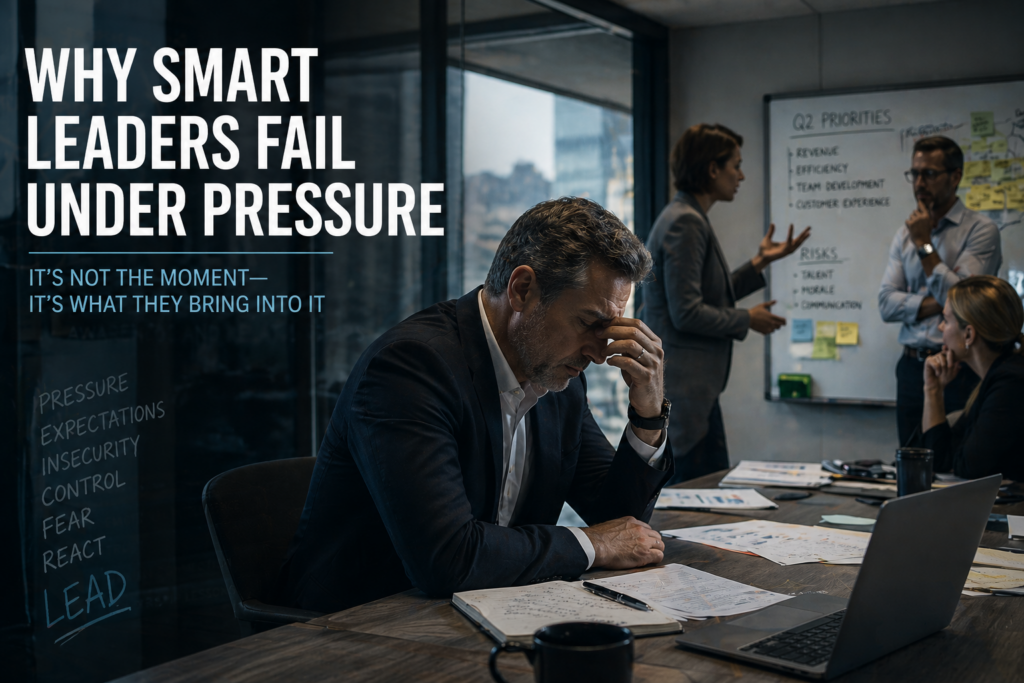
It’s not the moment—it’s what they bring into it
There’s something I’ve noticed over time that doesn’t get talked about much when it comes to leadership.
We spend a lot of time talking about what leaders should do under pressure—stay calm, communicate clearly, lead with confidence—but we don’t spend much time talking about why that breaks down in the first place.
And it breaks down a lot.
You can have someone who is sharp, experienced, technically strong, knows their job inside and out—and the second things get tense, the second they feel challenged, something shifts. Not gradually. Not thoughtfully. It just flips.
And when it flips, it’s not subtle.
I’ve seen this pattern enough times now that it’s hard to ignore.
What stands out to me isn’t even the reaction itself—it’s what happens before the reaction.
Most people don’t go from calm and collected to explosive out of nowhere.
They’ve been building toward it.
Quietly.
A lot of what I see is passive behavior leading up to those moments.
People avoid conversations that need to happen. They don’t address tension when it’s small and manageable. They don’t define expectations clearly. They let things slide because they don’t want to deal with the discomfort of addressing it directly.
So things sit.
And sit.
And sit.
Then at some point, they can’t avoid it anymore—or someone asks a direct question—and instead of responding to the moment, they respond to everything they’ve been holding.
That’s when you get the explosion.
There’s also a lot of pretending.
People pretend everything is fine. They pretend they’ve communicated clearly. They pretend they’re confident and in control. If something goes wrong, it’s someone else’s issue.
Very rarely do you hear someone say, “I’m struggling with how to handle this,” or “I haven’t figured out how to reach this person yet.”
It’s almost always externalized.
The problem is the person. The team. The situation.
Not them.
Another big signal before things break down is control.
You start to see micromanagement creep in. Over-editing. Over-involvement. Leaders inserting themselves into things they don’t need to be part of.
Trying to control outcomes instead of developing capability.
And a lot of times, they’re enforcing standards that were never actually defined. They expect people to think the way they think, communicate the way they communicate, and when that doesn’t happen, frustration builds.
But the expectation was never clear in the first place.
All of that builds pressure.
But here’s the part that changed how I think about this.
The flip—the moment everyone sees—it’s not actually happening in the meeting.
It’s happening before people even walk in the building.
I’ve known multiple people who sit in their car before work trying to get themselves together before they go inside.
People who deal with constant stress responses—migraines, stomach issues, anxiety—tied directly to their work environment.
People who are already worked up before a single conversation happens.
So when something small happens—a question, a disagreement, a missed answer—it’s not small to them.
It hits everything they’re already carrying.
That’s why the reaction feels immediate.
Because internally, it’s not immediate at all.
It’s been building for hours, days, years in some cases.
At the center of it, what I see most often is insecurity.
People don’t feel solid in their role. They don’t feel confident in their ability to lead. They feel like they should have all the answers, and when they don’t, it doesn’t feel like a normal moment—it feels like exposure.
Like they’re about to be found out.
You see it a lot in how people respond to competence in others.
Someone on their team knows something they don’t, and instead of getting curious, instead of leaning into it, they feel threatened.
There’s this strange attachment to title where being the leader is supposed to mean you’re the most capable person in the room.
And that’s just not true.
But if someone believes it is, every moment they don’t have the answer becomes a problem.
So what triggers the shift?
It’s usually something simple.
A direct question.
A challenge in a meeting.
Not having an answer right away.
Feeling like authority is slipping.
And that’s enough.
Because in that moment, it’s no longer about the work.
It’s about protecting themselves.
And that’s where things start to break down for everyone else.
When leaders operate from that place, people feel it.
They may not be able to name it, but they feel it.
They get quieter.
They stop offering ideas.
They start navigating the leader instead of doing the work.
Trust erodes.
Motivation shifts from doing good work to avoiding problems.
You start to see small groups form, people aligning with each other instead of the broader team.
And the best people—the ones who can contribute the most—either disengage or leave.
Because they don’t need to stay in an environment like that.
Now flip it.
Because not everyone responds this way.
When someone is grounded—actually comfortable in who they are—you can feel the difference pretty quickly.
They come into work with a baseline that’s simple and steady.
Do good work.
Respect the structure.
Keep improving.
They don’t expect perfection from themselves or anyone else, but they do expect effort and accountability.
When something goes wrong, they don’t take it personally.
They don’t swing emotionally.
They look at it, address it, and move on.
If they make a mistake, they say it plainly and fix it.
If someone on their team makes a mistake, they coach them through it.
If it’s something more serious, they handle it appropriately—but it’s still matter-of-fact, not emotional.
They’re also not threatened by people who know more than they do.
They get curious.
They ask questions.
They learn.
And because of that, they tend to build stronger teams.
Because people feel seen, feel safe, and feel like they can contribute without being shut down or judged.
There’s also a level of consistency.
They celebrate wins publicly.
They correct privately.
They take responsibility when things go wrong.
And when their team does something well, they push that forward.
The biggest difference, though, is how people feel around them.
People feel steady.
They feel protected, to the extent a leader can protect them.
They feel like they can try, stretch, even fail without it becoming something bigger than it needs to be.
And what comes out of that is usually a high-performing team.
Not because people are being pushed harder, but because they’re not spending their energy navigating unnecessary stress.
They’re just working.
There’s something else that comes up in these environments too, and it’s worth calling out.
A lot of organizations send mixed signals.
If someone doesn’t want to grow, they’re labeled as lacking ambition.
If someone does want to grow, they’re told to slow down and “know their place.”
It’s contradictory, and it puts people in a constant state of trying to read what’s actually expected of them.
That’s not a performance issue.
That’s leadership immaturity.
At the end of all of this, the pattern is pretty clear.
Smart people don’t fail under pressure because they don’t know what to do.
They fail because, in that moment, it stops being about what to do.
It becomes about how they feel—and they don’t know how to manage that.
And until that part is addressed, no amount of tools, training, or surface-level development is going to fix it.
There’s more underneath this than just “handling pressure better.”
I’ve been digging into it for a while now—trying to understand what actually changes behavior in those moments.
I’ll share more on that soon.