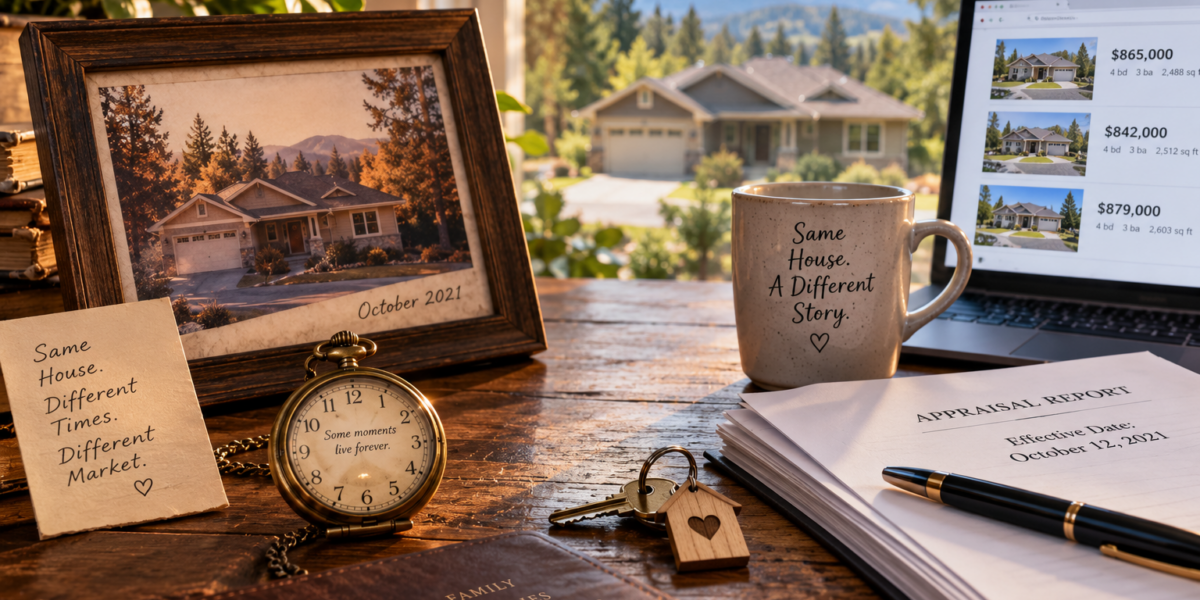
The appraisal was finished.
We had researched the property, gone back through the market, found sales from the relevant period and developed an opinion of what the home was worth when Dad passed away several years earlier.
Then came the question.
“But the house is worth more than that today.”
Yes. It probably is.
And that’s exactly where this particular kind of appraisal can become confusing, because the family is standing in today’s market looking at today’s house, today’s neighborhood sales and today’s Zillow estimate. The appraiser is trying to stand somewhere else entirely.
We’re trying to go back in time.
The House Is Here. The Value Date Isn’t.
Suppose Dad passed away in October 2021, and it’s now 2026.
For whatever reason, the family needs an appraisal of the property as of the date he passed away. Maybe an attorney requested it. Maybe the CPA needs it. Maybe the estate wasn’t handled immediately, or nobody knew an appraisal would eventually be needed.
The reason can vary, but now I’m walking through the house in 2026 and being asked a question about 2021. That’s a strange assignment when you think about it.
The roof I’m looking at is five years older. Maybe the kitchen has been remodeled or a bathroom added. The trees grew, the fence fell over and the neighborhood may have changed around it. Meanwhile, interest rates, buyer behavior and the larger real estate market may have changed considerably.
The family is living in 2026.
For purposes of this appraisal, our world of value stops at the effective date.
“But Zillow Says $850,000”
It might. The house might sell for $850,000 tomorrow.
That doesn’t necessarily tell us what it was worth five years ago.
This is where people can get frustrated because most of us experience value in the present tense. We ask, What’s my house worth? We don’t usually ask, What would buyers have paid for my house on a specific Tuesday several years ago, using the market conditions that existed around that time?
Appraisers do.
A retrospective appraisal develops an opinion of value as of a date in the past. The applicable date depends upon the assignment and its intended use, and that’s something the attorney, accountant, fiduciary or other appropriate professional may help establish.
Once we’re given that date, however, it matters enormously. If the effective date is October 12, 2021, I’m not free to decide I’d rather value the house in September 2026 because there are better comparable sales available.
That’s answering a different question.
Sometimes Yesterday’s Number Is Higher
Here’s the part that really scrambles people’s intuition.
Retrospective doesn’t automatically mean lower.
Imagine someone passed away near the top of a particularly strong local market. Several years later, the family finally orders the appraisal and assumes the house must be worth more now because several years have passed.
Then the research says otherwise.
Prices may have declined. Mortgage rates may have risen and changed buyer purchasing power. That particular property type may have become less desirable, or the broader market may have recovered while this little pocket of properties didn’t.
The house aged five years. The calendar moved forward.
Value doesn’t have to.
I’ve encountered properties where looking backward meant looking into a stronger market than the one surrounding the house today. That’s one of the reasons appraisers shouldn’t begin with a story about what real estate “always” does.
The market gets a vote.
Real Estate Doesn’t Accumulate Value Like Birthdays
We tend to talk about houses as though appreciation is something they collect simply by surviving another year: bought for $300,000, then worth $400,000, then $500,000, then $600,000. Nice clean staircase.
Anyone who owned California real estate through the mid-2000s knows that’s not how this works.
A property can increase dramatically in value, lose a substantial portion of it, recover over years, accelerate again and then enter another period where higher interest rates or changing demand slow the market. The house may barely change during any of it.
That’s because value doesn’t live inside the walls. It comes from the interaction between the property and the market around it. Buyers, financing, supply, demand, employment, interest rates, competing properties and consumer confidence can all change while the kitchen cabinets remain exactly where somebody installed them in 1997.
So How Do You Appraise a House Five Years Ago?
We don’t get a time machine, unfortunately, but we do have evidence.
For a retrospective assignment, we’re trying to reconstruct the market that existed around the effective date. That means looking at the properties that were competing with the subject, what had recently sold, what buyers were paying and how long homes were taking to sell. We want to understand whether sellers were generally receiving their asking prices, whether inventory was tight or plentiful, whether demand was strengthening or weakening, and whether that particular neighborhood or property type was behaving differently from the larger market.
Just as importantly, we need to understand what the subject property was like at the time.
If I’m standing in a remodeled kitchen today but the remodel happened in 2024, I can’t pretend the 2021 house had it. If an accessory dwelling unit was built later, it wasn’t part of the earlier property. If the roof was replaced after the relevant date, I need to understand what roof existed then.
That’s where the work can become part valuation and part archaeology. Old photographs, MLS listings, permit histories, receipts, contractor records and conversations with people familiar with the property can all help us reconstruct what existed.
We’re trying to understand both a house and a market that no longer exist exactly as they did.
What About a Sale That Happened After Dad Passed?
This is where retrospective appraisal gets more nuanced than simply drawing a line through the calendar and refusing to look at anything on the other side.
Later information can sometimes help us understand or confirm what was happening around the effective date, but we have to be careful. An appraiser shouldn’t take a sale from years later, drag it backward and pretend buyers on the effective date knew the future.
They didn’t.
The question is what market participants knew, expected and were responding to around the relevant time. A sale shortly after the effective date may sometimes provide useful evidence, depending upon the property and what was happening in the market. A sale years later in a substantially different market may tell us very little about the earlier value.
This is why retrospective appraisal isn’t simply about finding old comparable sales. We’re trying to reconstruct the old market.
Those are different jobs.
“But We Could Sell It for More Today.”
You may be absolutely right.
And if you’re deciding whether to sell the property today, today’s value matters. But if the CPA, attorney or estate professional needs a value as of the date Dad passed away, today’s value answers the wrong question.
Think about two photographs of the same child, one taken at age ten and another at age fifteen. The fifteen-year-old photograph doesn’t make the ten-year-old photograph inaccurate. They’re the same person at different points in time.
Real estate valuation works similarly.
A 2021 appraisal and a 2026 appraisal of the same property can reach substantially different conclusions and both can be correct for the questions they were asked to answer.
That’s the part people sometimes miss.
An appraisal conclusion belongs to a date.
The Old Appraisal Isn’t Wrong Just Because the House Is Worth More Now
This comes up outside estate work too.
Someone finds an old appraisal in a drawer and compares it with what the house is worth today.
“That appraiser was way low.”
Maybe. Appraisers can absolutely be wrong.
But the fact that the property later sold for more doesn’t prove it. You have to go back and ask what the market supported then.
The reverse is true too. If an appraisal completed near the height of a market indicated $900,000 and the house later sells for $750,000, that doesn’t automatically mean the earlier appraiser was high.
Maybe the market changed.
That’s not an excuse. It’s the entire point of having an effective date.
The Family Still Lives in Today
This is where the technical explanation bumps into real life again.
The family isn’t living in the historical market. They’re standing in Dad’s house now. Maybe they’ve spent several years maintaining it. Maybe they’ve remodeled it. Maybe they’ve watched neighboring homes sell for prices Dad never would have imagined.
Then an appraiser arrives and starts talking about a market that disappeared years ago.
It can feel artificial.
But we’re not saying the house is worth that amount today. We’re saying the evidence indicates it was worth that amount then.
That distinction can matter for estate administration, tax questions, litigation and other financial decisions, which is why the appropriate professionals may need the historical value established in the first place. The appraiser doesn’t determine which date the law or tax rules require. We answer the valuation question we’re given.
Sometimes the Calendar Is the Most Important Comparable
People naturally focus on the houses in an appraisal. Which sales did you use? How big were they? How close were they? Did they have acreage? Were they remodeled?
Those things matter.
But in a retrospective appraisal, there’s another comparison happening underneath all of them:
When did this happen?
A nearly identical house selling today can sometimes be less relevant than a somewhat different house that sold when buyers were operating under the same market conditions as the effective date.
That’s hard to see when you’re standing in the present.
It’s our job to go looking for it.
So when someone looks at a retrospective appraisal and says, “But the house is worth more than that today,” the answer may simply be:
Yes. Today just wasn’t the question.
Christopher Pyle has more than 20 years of real estate appraisal experience in Northern California. He works alongside his mother, longtime appraiser Christine Pyle Banks, at AppraiserChris.com, their family appraisal practice serving the Sacramento region and Sierra Nevada foothills. His work focuses on helping homeowners, families and professionals better understand property value and the decisions that surround it.